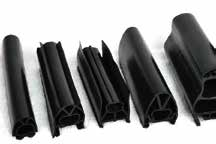
Refrigerator door gaskets perform a highly specific mechanical function. They maintain thermal efficiency, block condensation, and keep appliances compliant with strict energy standards. Producing these seals at high volumes introduces distinct manufacturing hurdles. Plant managers must hold tight dimensional tolerances while managing polymer shrinkage. If the profile warps during cooling, the end-user deals with permanent wrinkles and failed suction. Integrating magnetic strips directly into the workflow without slowing down the haul-off speed adds another layer of difficulty. Overcoming high scrap rates and inconsistent geometries means abandoning generic plastic processing equipment. Facilities need a specialized refrigerator door gasket extrusion machine. This equipment provides the precise thermal regulation and mechanical control required to extrude complex, multi-chambered profiles consistently.
Material Versatility is Mandatory: Modern production requires equipment capable of handling multiple polymers, making a flexible PVC TPU TPE sealing profile extrusion line critical for adapting to market demands.
Precision Dictates Yield: The most significant variable in gasket manufacturing profitability is the calibration and cooling process, which prevents profile deformation, eliminates surface wrinkles, and ensures airtight appliance seals.
Automation Reduces Operating Costs: Integrating inline magnetic strip insertion, automated cutting, and welding directly into the extrusion line drastically reduces labor costs and assembly bottlenecks.
Vendor Selection is a Partnership: Choosing a profile extrusion machine manufacturer must be based on post-sale support, tooling customization capabilities, and proven Factory Acceptance Testing (FAT) protocols.
The Anatomy and Material Science of Refrigerator Seals
Success Criteria Framing
Successful extrusion starts with a strict definition of end-product requirements. Refrigerator seals operate in harsh environments. They must maintain flexibility at temperatures dropping below -20°C in freezer applications. They require high chemical resistance to withstand aggressive cleaning agents, food acids, and oils. Airtight compression is non-negotiable for energy efficiency ratings. Structural integrity dictates proper magnetic adherence. If the profile collapses or warps during extrusion, the internal magnet will not sit flush against the steel appliance frame. This creates micro-gaps, leading to air leaks, rapid frost buildup, and overworked compressors.
Material Selection Trade-offs
Choosing the right polymer dictates the extruder screw design, heating profiles, and cooling bath lengths. You must balance raw material costs against long-term field performance.
Soft PVC: Polyvinyl chloride remains the legacy choice. It offers extreme cost-effectiveness and highly reliable welding during the final 45-degree frame assembly. However, plasticizer migration over time causes PVC seals to stiffen, discolor, and crack. Environmental regulations regarding its production and disposal continue to push manufacturers toward cleaner alternatives.
TPE/TPU: The industry is shifting toward thermoplastic elastomers (TPE) and polyurethanes (TPU). These materials provide superior low-temperature flexibility and excellent compression set recovery. They are fully recyclable and do not release toxic byproducts during processing. They maintain their elastic memory much longer than PVC, ensuring a tight seal for the entire lifecycle of the appliance.
Material Type
Low-Temp Flexibility
Compression Set Recovery
Weldability
Primary Application
Soft PVC
Moderate
Average
Excellent
Budget residential units
TPE
High
Excellent
Good (requires specific tooling)
Modern eco-friendly appliances
TPU
Very High
Outstanding
Good
Heavy-duty commercial refrigeration
Mounting Geometries and Profile Complexity
The extrusion process must accommodate various installation methods dictated by the appliance design. Each geometry requires entirely different die designs and calibration tooling.
Dart-Style Push-In Seals: Common in residential units. The gasket features a rigid or semi-rigid arrow-shaped spine that presses into a pre-routed groove in the plastic door liner.
U-Channel Extrusions: Used in commercial heavy-duty units. The gasket wraps around the edge of a stainless steel door panel, requiring a tight friction fit.
Hidden Screw-On Channels: Older or specialized designs where the gasket is mechanically fastened to the door under a concealed flap.
The hollow bellows of the seal must compress easily when the door closes but spring back instantly when opened. Achieving this dynamic movement requires precise wall thickness control, often down to tolerances of 0.1 millimeters during extrusion.
Co-Extrusion Requirements
Many modern gaskets utilize co-extrusion technology. This involves extruding a rigid spine (often Shore D hardness) for door mounting alongside a soft, flexible bellows (Shore A hardness) for the seal itself. You cannot achieve this with a single extruder. It requires specialized multi-layer die heads fed by synchronized multi-extruder setups. The rigid material provides the structural grip needed to stay in the door track, while the soft material provides the airtight cushion. The thermal bonding between these two distinct polymer streams must happen seamlessly within the die head under high pressure before cooling begins.
Step-by-Step: The Extrusion Manufacturing Process
Raw Material Feeding and Plasticization
The process starts at the material handling stage. Gravimetric dosing units ensure precise blending of virgin resin, regrind, and color masterbatch before the polymer enters the feed throat. Inside the barrel, a rotating screw shears and melts the plastic. Temperature control across the barrel zones is critical. If the melt temperature is too low, the material will not flow properly, causing high head pressure. If it is too high, the polymer degrades, leading to burn marks and loss of physical properties. The screw design—specifically the compression ratio and flight depth—must match the specific material being processed to ensure a homogeneous melt without excessive shear heating.
Die Design and Profile Shaping
The molten polymer is forced through custom tooling known as the extrusion die. This shapes the complex, multi-chambered cross-section of the refrigerator seal. Die design relies on highly specialized fluid dynamics. Engineers must account for die swell, which is the tendency of the polymer to expand as it exits the restrictive tooling. The internal flow channels (the land length) of the die must balance the speed of the material perfectly. If the polymer flows faster on the thicker spine section than on the thin bellows section, the profile will warp and twist instantly upon exiting the die.
Cooling and Vacuum Calibration
This is the most sensitive transition in the entire process. The profile moves from the hot die into chilled water cooling tanks. Vacuum sizing tables prevent the hollow chambers of the gasket from collapsing while the polymer solidifies. The vacuum pulls the outer skin of the profile against brass or stainless steel sizing blocks. Meanwhile, turbulent chilled water removes the heat. If the cooling is uneven, internal stresses build up within the polymer matrix, leading to permanent deformation and shrinkage hours after the product is spooled or cut.
Inline Processing and Finishing
Once the profile is cooled and dimensionally stable, downstream processes take over. Automated insertion mechanisms feed the continuous magnetic strip directly into the designated chamber of the gasket. Precise haul-off units use specialized rubber belts to pull the profile at a constant speed. The pulling tension must be perfectly calibrated to prevent stretching the warm polymer. Finally, automated servo-driven cutting units slice the continuous profile into exact lengths required for door frame assembly, ensuring clean, square cuts for downstream welding.
Inline Quality Control
Modern production relies on automated optical inspection systems and laser micrometers. These sensors verify profile dimensions and structural integrity in real-time. They check for proper magnetic strip seating, correct wall thickness, and overall profile width. Ensuring the final product meets exact specifications means it will pass consumer-level airtightness tests. Plant managers want to avoid situations where end-users must use boiling water treatments or hair dryers to fix warped seals that failed to conform to the appliance frame.
Core Components of a Refrigerator Door Gasket Extrusion Machine
Extruder Specifications
Standard soft PVC processing typically relies on single-screw extruders with a length-to-diameter (L/D) ratio of 24:1 or 28:1. These feature deep-flighted screws optimized for PVC's heat sensitivity. However, processing advanced elastomers requires a highly efficient TPE seal strip extrusion machine. These machines feature barrier flight screws designed to ensure complete melting of the elastomer without material stagnation. They also require higher torque gearboxes and more robust barrel heating systems to handle the higher processing temperatures of TPE and TPU.
Co-Extrusion Tooling
Multi-layer die heads are complex pieces of engineering. They allow the simultaneous extrusion of different material durometers. You can combine a hard PVC base with a soft TPE bellows. The tooling utilizes Y-block distributors to manage two different melt streams, bringing them together just before the die exit. The flow channels must be highly polished to prevent material hang-up and degradation. Quick-change features on these die heads save hours of downtime during product changeovers, allowing operators to swap profile plates without dismantling the entire die assembly.
Downstream Automation Integration
A continuous line is only as fast as its slowest component. Synchronized haul-off units use caterpillar tracks to grip the profile gently but firmly, preventing crushing of the hollow chambers. Inline punching and notching systems prepare the gasket for final assembly, cutting out specific sections where the gasket will fold at the corners. Finally, offline 45-degree corner welding machines transform the cut profiles into finished, airtight door frames. Integrating the magnetic insertion and cutting steps directly into the extrusion line maximizes throughput and minimizes handling damage.
Evaluating a PVC TPU TPE Sealing Profile Extrusion Line
Adaptability for Thousands of Profile Models
Manufacturers often produce thousands of different OEM and aftermarket gasket models. This requires a PVC TPU TPE sealing profile extrusion line that can handle rapid changeovers. You need equipment that supports quick-change tooling for both commercial refrigeration and residential units. A machine locked into a single profile type or material will quickly become a bottleneck in a diverse manufacturing facility. Look for modular calibration tables that allow operators to swap vacuum blocks in minutes rather than hours.
Production Speed vs. Quality Metrics
Line speed is typically measured in meters per minute. While high speeds (15-25 m/min) increase output, they also elevate the risk of dimensional instability. Higher speeds require exponentially more efficient cooling systems. If you push the profile through the water bath too quickly, the core remains hot. This leads to post-extrusion shrinkage once the product is packed. Evaluating a machine means finding the optimal balance between maximum throughput and zero-defect quality, often requiring extended cooling tanks or secondary chilling baths.
Precision Control and Tolerance Management
Maintaining wall thickness and profile geometry requires advanced control systems. Programmable Logic Controllers (PLCs) manage every heating zone, melt pressure transducer, and motor speed. Inline laser micrometers provide closed-loop feedback. If the profile thickness deviates by even a fraction of a millimeter, the system automatically adjusts the haul-off speed or extruder RPM to correct it. This eliminates reliance on manual operator adjustments and ensures consistent quality across different shifts.
Energy Efficiency and Operational Costs
Extrusion is an energy-intensive process. You must analyze the power consumption of heating zones, vacuum pumps, and chilling units. Modern servo-driven motors reduce long-term operational costs significantly compared to older AC or DC drives. Insulated barrel heaters also prevent heat loss, directing energy into the polymer rather than the factory air. Variable frequency drives (VFDs) on vacuum pumps ensure they only draw the power necessary to maintain the required vacuum level, further reducing electricity usage.
Implementation Risks and Mitigation in Gasket Manufacturing
Managing Material Shrinkage and Deformation
Polymer shrinkage post-extrusion is an unavoidable reality. As the plastic cools, molecular chains contract. If this is not managed, the gasket will shrink and fall out of the door frame. Mitigation strategies focus on optimized cooling bath temperatures and extended annealing zones. You also need tension-free haul-off calibration. If the haul-off pulls the profile too hard while it is still warm, it induces artificial stretch. When the profile finally cools, it snaps back, resulting in a gasket that is too short for the door frame.
Preventing Surface Wrinkles
Uneven cooling or improper vacuum calibration causes permanent wrinkles in the bellows. These wrinkles create gaps between the door and the appliance body. This leads to failed door seals, condensation, and high warranty claim rates. Ensuring consistent water flow and stable vacuum pressure in the calibration tank is the only way to produce a perfectly smooth, airtight seal. Operators must regularly check vacuum slots in the sizing blocks to ensure they are not clogged with polymer residue or hard water deposits.
Tooling Changeover Times
For facilities running a custom gasket extrusion line, downtime is a massive risk. Changing dies and calibrators for different appliance models can take hours if the equipment is poorly designed. You should look for machines featuring quick-release clamps, easily accessible water manifolds, and modular vacuum connections. Applying Single Minute Exchange of Die (SMED) principles and utilizing well-designed machinery reduces changeover time from hours to minutes, drastically improving overall equipment effectiveness.
Operator Training and Maintenance Protocols
Operating a sealing strip extrusion line requires specialized knowledge. Operators must understand how to troubleshoot die swell, flow imbalances, and vacuum fluctuations. Robust vendor training is essential. Maintenance protocols must include regular cleaning of the die head to prevent degraded material from causing surface streaks. Vacuum pumps and water filters also require strict maintenance schedules to ensure consistent cooling performance and prevent unexpected line stoppages.
Common Defect
Probable Cause
Corrective Action
Surface Wrinkles
Insufficient vacuum in calibration block
Clear vacuum slots; increase pump pressure
Profile Shrinkage
Excessive haul-off tension
Reduce haul-off speed; check cooling water temp
Poor Magnetic Adhesion
Chamber wall too thick or warped
Adjust die bolts to balance polymer flow
Burn Marks
Material stagnation in die head
Lower zone temperatures; clean die channels
How to Choose a Profile Extrusion Machine Manufacturer
Technical Support and Spare Parts Availability
Your evaluation must center around minimizing unplanned downtime. Assess the supply chain of your chosen profile extrusion machine manufacturer. Critical components like screws, barrels, heating bands, and specialized PLC modules must be readily available. If a drive fails, you need a replacement shipped immediately. Lack of local support, remote diagnostic capabilities, or delayed spare parts can paralyze your production line for weeks, causing missed delivery dates to appliance OEMs.
Custom Tooling and R&D Capabilities
The best machinery providers do more than just build extruders. They design and test custom dies in-house before shipping the equipment. Evaluate the vendor's R&D capabilities. Can they take a CAD drawing of a new gasket profile, run flow simulation software, and deliver a fully functional die? Their ability to optimize tooling design directly impacts your time-to-market for new appliance models and reduces the amount of trial-and-error required on your factory floor.
Factory Acceptance Testing (FAT) Criteria
Never accept delivery without a rigorous FAT. Define the non-negotiable benchmarks your new refrigerator gasket machine must hit. This includes sustained run times at maximum rated speeds for at least 8 hours. It must also include strict scrap rate maximums and dimensional accuracy validation across multiple profile types. The machine must prove it can handle your specific raw materials flawlessly before it leaves the vendor's facility.
Conclusion
Audit your current scrap rates to identify specific cooling, calibration, or shrinkage failures on your existing lines.
Define your required output capacity in meters per minute to size the extruder screw and cooling tanks correctly.
Document your material roadmap to determine if you need equipment capable of processing both PVC and TPE.
Request detailed technical proposals and tooling flow simulation capabilities from specialized extrusion machinery manufacturers.
Schedule a comprehensive Factory Acceptance Test using your own raw materials and magnetic strips.
FAQ
Q: What is the average production speed of a refrigerator door gasket extrusion machine?
A: Standard production speeds range from 10 to 25 meters per minute. The exact rate depends heavily on material choice and profile complexity. Thicker commercial gaskets require slower speeds to ensure proper cooling, while thinner residential profiles can run much faster.
Q: Can a single sealing strip extrusion line process both PVC and TPE?
A: Yes, but it requires specific engineering. You must use an extruder with a versatile barrier screw design and precise temperature control zones. TPE generally requires different shear rates and thermal management than soft PVC to prevent material degradation.
Q: How do manufacturing defects impact the final refrigerator door seal?
A: Improper extrusion tension or uneven cooling causes permanent wrinkles and rigid spots. This prevents the gasket from compressing properly against the appliance frame. Consumers often attempt to fix these bad seals with boiling water or hair dryers, which only provides a temporary solution.
Q: How is the magnetic strip inserted into the refrigerator gasket?
A: The magnetic strip is inserted inline immediately after the profile exits the cooling tanks. An automated uncoiling and feeding mechanism guides the flexible magnet into a specific hollow chamber of the gasket before it reaches the final cutting stage.
Q: What causes wrinkles or deformities in extruded refrigerator seals?
A: The primary culprits are uneven cooling, improper vacuum calibration, or inconsistent haul-off tension. If the vacuum fails to hold the profile shape against the sizing blocks while the plastic cools, the hollow bellows will collapse and permanently wrinkle.
Q: How often does the extrusion die need to be cleaned or replaced?
A: Dies should be cleaned during every major material or profile changeover. Regular maintenance prevents degraded polymer buildup, which causes surface streaks. With proper care and non-abrasive cleaning, high-quality steel dies can last for years before requiring replacement due to wear.