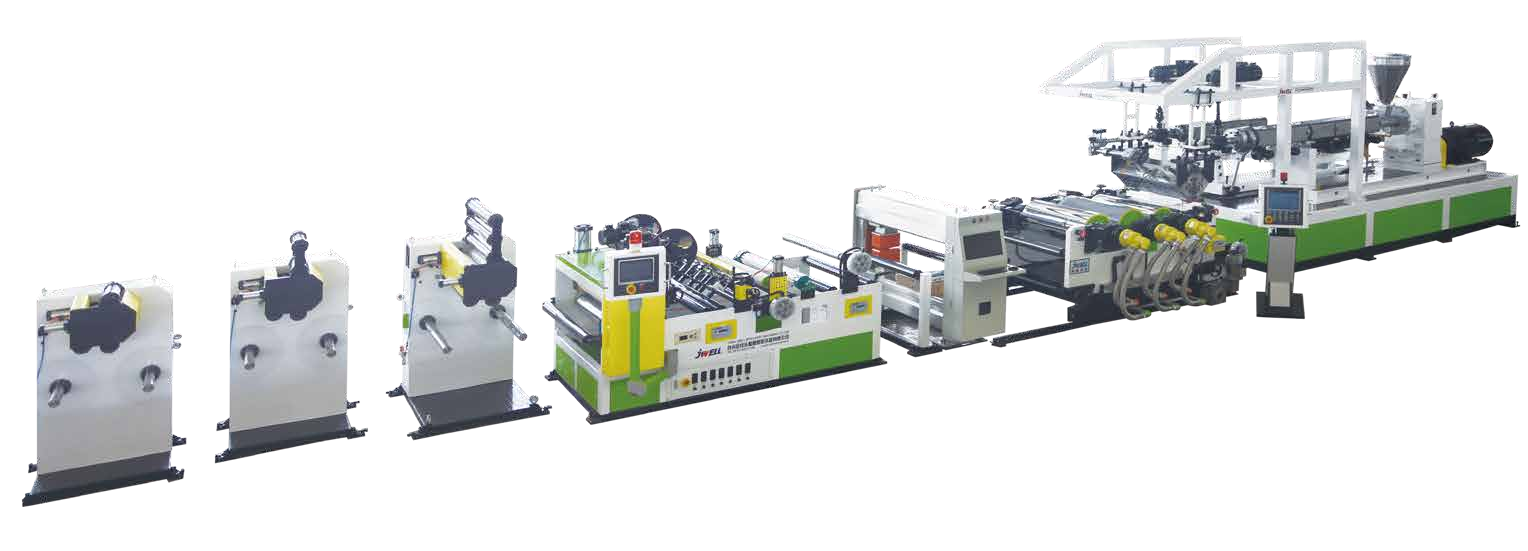
The production line for TPU (Thermoplastic Polyurethane) invisible braces is designed to manufacture high-quality, clear orthodontic aligners used for teeth straightening. These aligners need to be precisely formed to fit individual dental structures, offering comfort, transparency, and durability. Here is an introduction to the components and features of Jwell TPU invisible braces production line:
Main Parts of Production Line:
1. Raw Material Handling and Feeding:
Raw Material Storage: High-quality TPU pellets or sheets specifically formulated for medical applications are stored in controlled environments to prevent contamination.
Feeding System: Automated feeding systems deliver the TPU materials consistently into the extrusion or thermoforming system.
2. Extrusion System (if producing TPU sheets):
Extruder: Melts and homogenizes TPU pellets. A single or twin-screw extruder may be used depending on the specific requirements.
Temperature Control: Precise control of the extruder temperature ensures consistent melting and quality of the TPU sheets.
3. Sheet Formation (if producing TPU sheets):
Calendering Unit: Calender rolls form the melted TPU into thin, uniform sheets. The rolls are temperature-controlled for even cooling and a smooth surface finish.
Winding Unit: Rolls the finished TPU sheets into coils for easy handling and storage.
Production Line Features:
Precision Manufacturing: High-precision machinery and molds ensure that each aligner fits perfectly and functions effectively.
Quality Control: Rigorous quality control processes are essential to ensure the high standards required for medical devices.
Customization: The ability to produce aligners tailored to individual dental profiles based on digital scans and 3D printing technology.
Material Handling: Special handling of TPU materials to maintain their transparency and medical-grade quality.
Efficiency: High-speed production capabilities with minimal downtime for maintenance.
Applications:
TPU invisible braces produced on these lines are used in orthodontics for:
Teeth Straightening: Gradually moving teeth into the desired position with a series of custom-made aligners.
Bite Correction: Addressing issues such as overbite, underbite, crossbite, and open bite.
Dental Arch Alignment: Improving the alignment of dental arches for aesthetic and functional benefits.
The production line for TPU invisible braces is a sophisticated system designed to manufacture high-quality, custom-fit aligners. Emphasizing precision, efficiency, and stringent quality control, these lines produce aligners that meet the specific needs of orthodontic treatments, providing patients with an effective and aesthetically pleasing solution for teeth straightening and bite correction.
Main Technical Parameters:
| Model | Products Width(mm) | Products Thickness(mm) | Max. Capacity(kg/h) |
| JWS65 | 400-700 | 0.3-1.0 | 30-50 |
| JWS55+JWS80 | 600-900 | 0.3-1.0 | 50-120 |
| JWS45+JWS80+JWS45 | 600-900 | 0.3-1.0 | 80-150 |
Note: The specifications are subject to change without prior notice.
|
Advantages of TPU Invisible Braces:
Aesthetics: Almost completely invisible. You will complete your orthodontic treatment without anyone noticing, solving many patients' aesthetic concerns about straightening their teeth.
Comfort: Without brackets, wires and other orthodontic devices in the traditional sense, the orthodontic process is no longer painful. There is minimal irritation and discomfort to periodontal tissues.
Convenience: You can take them off and on without interfering with socializing, eating or exercising. At the same time, the number of follow-up visits is reduced, saving your valuable time.
Easy to clean: Oral hygiene is easy to maintain without worrying about gingivitis, tooth demineralization, discoloration, etc.
The TPU orthodontic sheet extrusion line manufactured by Jwell Machinery enables precise control over every stage from raw material to final forming. Processes such as drying and dehumidification, melt plasticization, precise temperature control, and uniform forming are all carefully managed to ensure the high elasticity and transparency of orthodontic sheets. When selecting equipment, factors such as production requirements, control accuracy, and energy efficiency must be considered. Advanced systems are also equipped with intelligent temperature control and modular design.
In the field of orthodontics, a material known as TPU sheets is commonly used to produce dental aligners. The specialized equipment used to manufacture these sheets is called a TPU orthodontic sheet extrusion line. This system typically consists of multiple functional units that work together to complete the entire process from raw materials to finished products.
TPU, or thermoplastic polyurethane, is a widely used polymer material. It offers elasticity, wear resistance, and transparency, making it suitable for applications requiring long-term wear. TPU orthodontic sheet extrusion lines are specifically designed to process this type of material.
The workflow of the system can generally be divided into several stages:
1. Raw Material Processing
TPU raw materials are usually in pellet form and must be dried to remove any residual moisture. Excess moisture can cause bubbles during heating, affecting product quality. Drying is typically performed in a hopper dryer, where temperature and airflow are controlled to achieve effective dehumidification.
2. Melt Plasticization
The dried TPU pellets are fed into an extruder. Inside the extruder, one or more screws rotate under controlled heating, gradually melting the material into a viscous flow state. Temperature control is critical in this stage. If the temperature is too low, plasticization will be incomplete; if too high, material degradation may occur. Modern extruders are equipped with precise multi-zone temperature control systems.
3. Forming
The molten TPU passes through a die to form sheet material. The die design plays a crucial role in determining thickness uniformity and surface smoothness. The formed sheet is immediately cooled using cooling rollers to solidify and stabilize its shape. Cooling temperature and time must be carefully controlled to ensure dimensional stability.
4. Winding or Cutting
Depending on downstream requirements, the finished sheet is either wound into rolls or cut into specific sizes. Proper tension control is essential at this stage to prevent deformation or wrinkling.
In addition to these core stages, modern TPU sheet extrusion lines may include auxiliary systems such as:
1. Automatic gravimetric feeding systems for precise material dosing
2. Online thickness measurement systems for real-time monitoring and feedback control
3. Static elimination devices to prevent dust attraction
4. Surface treatment units to enhance sheet performance
Several key parameters must be closely monitored during operation:
1. Temperature Control: Includes extruder zones, die temperature, and cooling conditions. Settings should follow material supplier recommendations.
2. Screw Speed: Affects output and melt pressure. Excessive speed can lead to uneven plasticization, while low speed reduces productivity.
3. Haul-off Speed: Must match extrusion speed to avoid overstretching or slackness.
4. Cooling Conditions: Influence crystallinity and internal stress, thereby affecting performance.
Maintenance of the extrusion line involves:
1. Regular cleaning of dies and cooling rollers
2. Inspection of screws and barrels for wear
3. Calibration of temperature control systems
4. Maintenance of transmission components such as gearboxes and bearings
When selecting a TPU orthodontic sheet extrusion line, consider:
1. Production capacity and product specifications
2. Control precision for thickness and surface quality
3. Energy efficiency
4. Ease of operation and maintenance
With advancements in material and control technologies, TPU sheet extrusion lines continue to evolve. New-generation systems developed by Jwell feature more advanced control systems for higher precision and improved user experience. Modular design also allows flexible configuration based on production needs.
In terms of safe operation, personnel should receive proper training and understand both the working principles and operating procedures. Emergency stop systems and safety protections must be regularly inspected. High-temperature surfaces should be clearly marked and protected to prevent burns, and electrical systems must be checked periodically to ensure proper insulation.
So in summary, Jwell TPU orthodontic sheet extrusion line is a specialized system designed for manufacturing TPU sheets used in dental aligners. By understanding its working principles and operational requirements, users can optimize performance and produce high-quality products that meet industry standards.