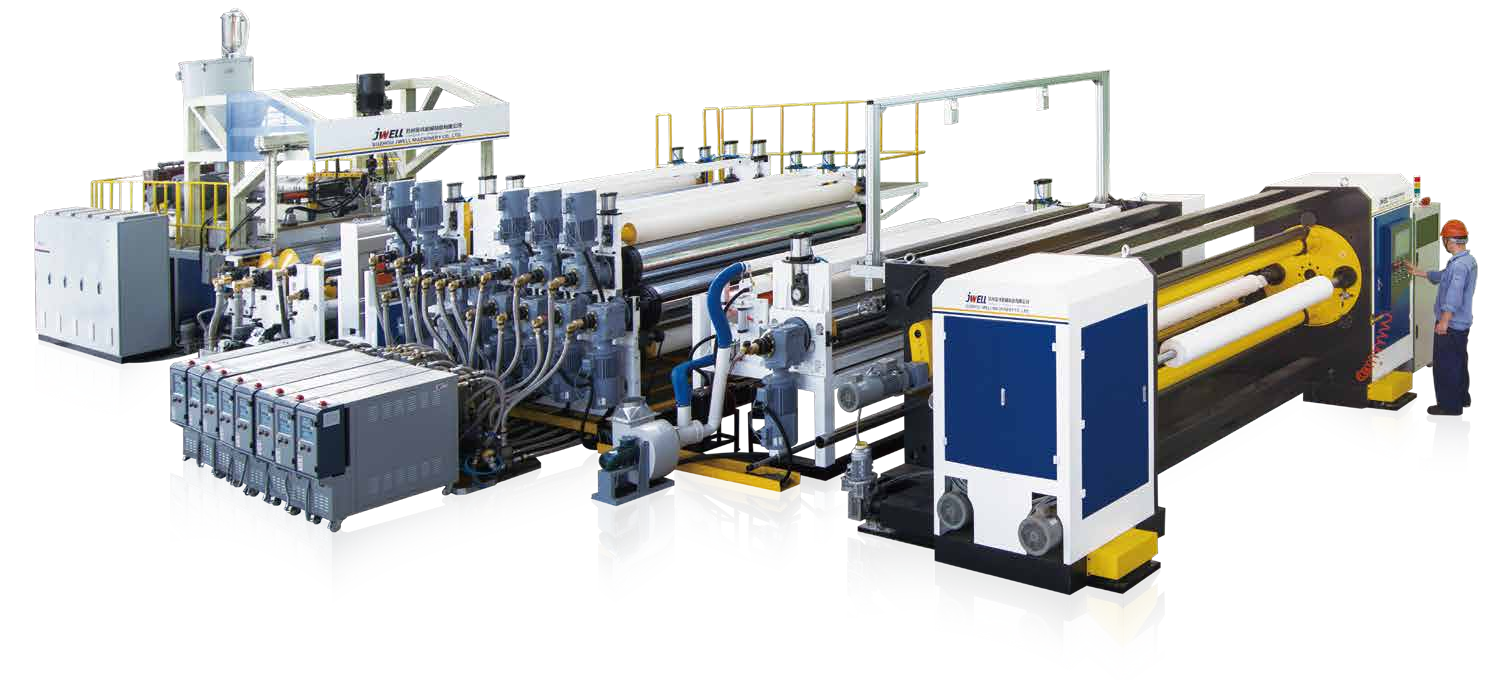
Main Parts of Production Line:
The production of PP (polypropylene) meltblown non-woven fabric is a sophisticated process used to create highly efficient filtration materials, medical masks, and other applications requiring fine fiber diameters and excellent filtration properties. Here’s an introduction to a typical PP meltblown non-woven fabric production line:
1. Raw Material Preparation
- polypropylene Resin: The primary raw material used is polypropylene granules, which are chosen for their melt properties and suitability for creating fine fibers.
- Additives: Stabilizers, pigments, and other additives may be mixed with the resin to enhance the properties of the final product.
2. Extrusion and Meltblowing Process
- Extruder: The polypropylene resin is fed into an extruder where it is melted and homogenized. The temperature and pressure are carefully controlled to ensure consistent melt quality.
- Metering Pump: The molten polymer is fed from the extruder to a metering pump, which ensures a consistent and precise flow rate to the die head.
- Die Head: The metered molten polymer is then forced through a die with numerous small nozzles. High-velocity hot air (supplied by air heaters and blowers) is used to draw the polymer into fine fibers as it exits the nozzles.
3. Fiber Formation
- Airflow Control: The high-velocity air stretches and cools the molten polymer into ultrafine fibers, typically in the range of 1 to 5 micrometers in diameter.
- Deposition: The fine fibers are deposited onto a moving conveyor or collection belt, forming a web of non-woven fabric. The airflow and collection distance are crucial to determining the fabric's properties, such as fiber diameter, basis weight, and uniformity.
4. Web Formation and Bonding
- Suction System: Below the conveyor, a suction system removes excess air and helps the fibers settle into a uniform web.
- Calendering: The web may pass through calender rolls, where heat and pressure are applied to bond the fibers, enhancing the fabric’s strength and integrity.
5. Quality Control
- Inspection: Continuous monitoring of the web for uniformity, thickness, and other quality parameters.
- Testing: Regular sampling and testing for properties such as fiber diameter, filtration efficiency, tensile strength, and other critical performance metrics.
6. Slitting and Winding
- Slitting: The wide web is slit into narrower widths as per customer requirements.
- Winding: The slit fabric is wound into rolls for easy handling, storage, and transportation. Automatic winding machines ensure consistent roll tension and alignment.
7. Packaging and Storage
- Packaging: The finished rolls are carefully packaged to protect them from contamination and physical damage during shipping.
- Storage: Rolls are stored in a controlled environment to maintain their properties until they are shipped to customers.
Equipment Involved
- Extruders: For melting and homogenizing the polypropylene resin.
- Metering Pumps: To control the flow rate of the molten polymer.
- Die Heads: Equipped with fine nozzles for fiber extrusion.
- Air Heaters and Blowers: To provide high-velocity hot air for fiber formation.
- Conveyors and Suction Systems: For fiber deposition and web formation.
- Calender Rolls: For bonding and strengthening the web.
- Slitting and Winding Machines: For cutting the web to size and winding it into rolls.
Main Technical Parameter:
| Model | Screw Diameter | Material | Products Width | Main Motor Power | Max. Capacity |
| JW65 | 65 | PP | 800mm | 22KW | 500-600Kkg/d(24h) |
| JW90 | 90 | PP | 1600mm | 45KW | 1200-1500kg/d(24h) |
| JW105 | 105 | PP | 2400mm | 55KW | 2000-2500kg/d(24h) |
| JW135 | 135 | PP | 3200mm | 75KW | 3000-3500kg/d(24h) |
Note: The specifications are subject to change without prior notice.
|


