2 The main applicatons
Include PE/PP, pipe, thick board recycling material pelletizing PS/ABS/PET sheet recycling material pellet-izing PE/PP film, woven bag recycling material pelletz-ing PA/PET waste yarn pelletizing.
3 High-Speed Extrusion Pelletizing Single-Screw Extruders for Enable Uniform Dispersion of Recycled Plastic
Challenge Category | Specific Problem | Solution / Structural Measure |
Gas/Vapor Interference | Moisture and low‑molecular‑weight volatiles cause bubbles, silver streaks, and non‑dense melt. | Use a vented screw with an atmospheric vent after compression; install barrier mixing sections and pin mixing sections to break gels and eliminate viscosity gradients. |
Low Bulk Density | Film shreds have loose density ~1/4 of virgin material; air entrapment makes compaction difficult. | Adopt a high L/D ratio screw with gradual channel depth reduction from feed to metering for progressive compaction; the extended length also provides space for multi‑stage mixing. |
Foreign Contaminants | Metal fines, sand, and paper fibers are inevitably introduced during shredding, causing defects. | Place a screen changer between screw tip and die head with multi‑layer screens; dual‑station design allows rapid screen changes without stopping, maintaining stable back pressure. |
Process Parameter Matching | Recyclates have fluctuating melt indices and are heat‑sensitive; shear and residence time must be precisely controlled. | Increase back pressure moderately to enhance reflux; tailor temperature profile for different melting points; balance screw speed to keep dispersion within thermal degradation limits. |
I. Pelletizing and utilization of recycled plastics constitute a core pathway for achieving closed-loop resource circulation, delivering both environmental benefits and economic returns. Reprocessing post-consumer plastic waste into recycled pellets that can be reintroduced into production reduces dependence on virgin petroleum-based feedstocks, alleviates white pollution, and offers the industrial chain a more cost‑competitive material alternative. As the circular economy concept gains deeper traction, recycled plastics have permeated a wide array of application fields, including packaging, building materials, automotive components, and electronic devices.
II. Nevertheless, the extrusion pelletizing stage for recycled plastics still faces multiple processing constraints. Feedstock properties fluctuate markedly due to diverse collection channels, often containing mixed resin types with widely varying melt flow indices, and surfaces frequently carry residual inks, adhesives, and other contaminants. Moisture content control poses difficulties—residual water from washing steps is hard to remove completely, and inadequate venting during high‑temperature melting can lead to bubbles or silver streaks on product surfaces. Foreign matter contamination is also pronounced: during shredding, non‑meltable materials such as metal fines, quartz sand particles, and paper fibers are inevitably introduced, becoming primary sources of subsequent molding defects. Moreover, repeated thermal histories cause a certain degree of molecular chain scission in the recyclate, resulting in notable fluctuations in melt strength and fluidity, which add extra difficulty to homogeneous plasticization.
III. To achieve a truly uniform dispersion, the recycling and pelletizing process must address the above bottlenecks in a targeted manner.
Resolving the interference of volatile gaseous components is the foremost prerequisite for ensuring dispersion quality. A vented screw configuration effectively tackles this issue: a atmospheric vent is positioned after the compression section, allowing moisture and low‑molecular‑weight volatiles to vaporize fully during the initial heating and melting stage, and then escape smoothly at the low‑pressure vent zone. This yields a dense, continuous melt stream, establishing a uniform medium for subsequent shear dispersion. Once gas interference is eliminated, the remaining primary obstacles are unmelted lumps, crosslinked particles, and viscosity differences among components with disparate melt flow indices. A single‑screw design with segmented geometry can resolve these—installing high‑shear mixing elements (e.g., barrier mixing sections) behind the vent to break up unmelted gel particles and agglomerates, while pin mixing sections enhance distributive mixing, eliminate internal viscosity gradients, and enable homogeneous blending of multiple components.
Recycled plastics exhibit low bulk density—for instance, the loose density of film shreds is typically only about one‑quarter that of virgin material. To counter this, the screw should adopt a relatively high length‑to‑diameter ratio, with a gradual transition from deep channels in the feed section to shallow channels in the metering section. This progressive compression forces entrained air out as the material softens upon heating, achieving thorough compaction. The extended L/D ratio also provides ample axial space for multi‑stage compounding, allowing dispersion to proceed stepwise and effectively avoiding material degradation caused by instantaneous high shear. At the end of the dispersion process, the filtration system performs final quality control—a screen changer positioned between the screw tip and the die head, equipped with multi‑layer combination screens, traps unmelted impurities. Its dual‑station design enables rapid screen replacement without stopping the line, maintaining stable back pressure and preventing re‑agglomeration of the dispersed phase.
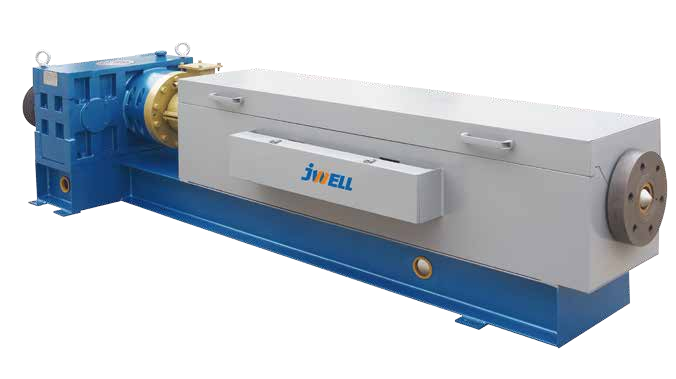
The effectiveness of the structural design ultimately hinges on precise matching of processing parameters. Back pressure directly influences shear intensity; moderately increasing back pressure in the metering section enhances melt reflux, forcing inadequately dispersed components to repeatedly pass through the mixing zones. Temperature profile settings must accommodate the melting requirements of recyclates with different melting points—ensuring that low‑melting fractions flow smoothly while high‑melting fractions do not remain as solid particles. Screw rotation speed selection requires balancing shear rate against residence time, so that the dispersion process is completed within the material’s thermal degradation threshold.
In summary, pelletizing and regeneration of recycled plastics is a critical link in the circular economy chain. Facing the practical challenges of feedstock heterogeneity, moisture, contaminants, and thermal degradation, Suzhou Jwellmech leverages a single‑screw vented configuration—using venting design to eliminate volatile interference, a high L/D ratio to compensate for low bulk density, a filtration system to block foreign matter, and fine‑tuned process parameters to ensure that shear efficiency, melting balance, and dispersion progress all stay within a safe thermal window, thereby achieving stable, high‑quality regenerated pellet output.


