NO.18, Dong'an Road, Chengxiang Industrial Zone, Taicang, Suzhou city, China
You are here:Home » Company » Newsroom » Industry News » Replacing Imports, Enhancing Quality And Efficiency: The Advantages of Chill Roll And Casting Rolls in Full-Range Stretch Production Lines for BOPP And Other Materials
Replacing Imports, Enhancing Quality And Efficiency: The Advantages of Chill Roll And Casting Rolls in Full-Range Stretch Production Lines for BOPP And Other Materials
Views: 100 Author: Site Editor Publish Time: 2026-04-10 Origin: Site
Application advantages of The chill roll and casting roll
broad adaptability and significant benefits
One
In the system of film stretching production technology, the master sheet casting process plays an irreplaceable foundational role. Master sheet casting refers to the process in which the molten polymer melt from the extruder, after being plasticized, is uniformly extruded through a die onto the surface of a rotating chill roll or casting roll, where it is rapidly cooled and solidified to form a solid sheet with a specific thickness, width, and surface characteristics. The core function of this process is to complete the phase transition from the viscous flow state to the rubbery state and even the glassy state, while initially establishing molecular orientation and crystalline structure. The quality of the master sheet—including thickness tolerance, surface flatness, internal crystallinity uniformity, and residual stress distribution—directly determines the success or failure of subsequent stretching processes and the quality of the final film. During biaxial or uniaxial stretching, any thickness fluctuations or micro-defects in the master sheet will be amplified multiple times, leading to film breakage, uneven thickness, increased haze, or degraded mechanical properties. Therefore, the casting system is a critical front-end process node in the entire stretching production line, and the quality of the master sheet is the primary prerequisite for high-end films such as BOPP, BOPET, and BOPA to meet the requirements of optical, electrical, or packaging applications.
Two
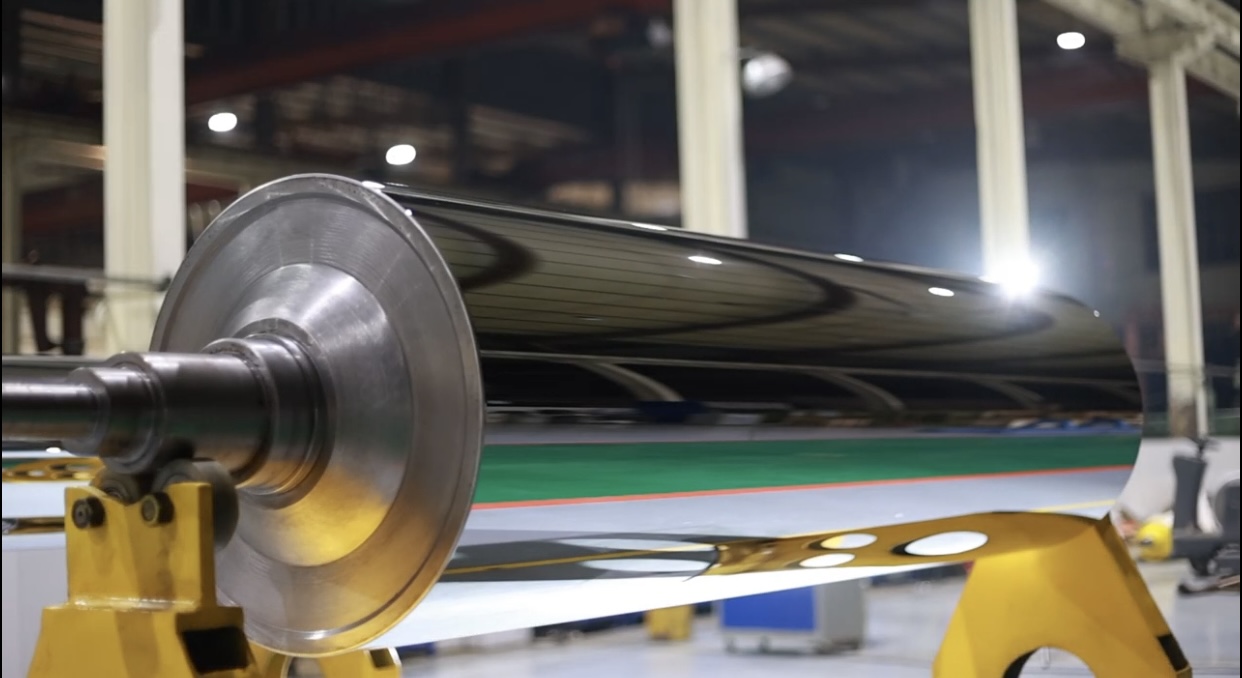
The chill roll and casting roll are the core execution components in the master sheet casting process. Their important functions can be summarized as "precise controllers of heat exchange" and "shapers of master sheet morphology." When the high-temperature melt (typically above 200°C) contacts the roll surface, the cooling medium circulating inside the roll must remove heat with extremely high efficiency, cooling the melt below its glass transition temperature within a very short time (usually a fraction of a second). This rapid cooling (quenching) process not only determines the cooling rate of the cast sheet, but more critically, requires that the cooling capacity be completely uniform across the entire width of the roll surface. If a temperature gradient exists on the roll surface, it will lead to differences in transverse crystallinity of the cast sheet, which in turn causes non-uniform deformation during subsequent stretching. Furthermore, the surface finish of the roll is directly transferred to the cast sheet surface, determining the apparent quality of the master sheet. The dynamic balance performance of the roll affects stability during high-speed operation, preventing mechanical vibration from being transmitted to the cast sheet and creating thickness variations (ripples). Therefore, the chill roll and casting roll are not merely simple conveying rolls, but rather core process components integrating efficient heat exchange, precise temperature control, surface shaping, and dynamic stability. It is precisely by virtue of breakthroughs in these key performance aspects that the casting rolls manufactured by Suzhou Jwell Precision Machinery Co., Ltd. have gained wide application on high-end European stretching production lines in China.
Three
Leveraging years of accumulated roll manufacturing experience, Suzhou Jwell has integrated multiple advanced and mature designs into its casting rolls. The maximum diameter can reach 1600 mm, meeting the demand for wide-width cast sheets in large-format film production lines while reducing edge effects. Internally, the roll features a variable-diameter staggered spiral flow channel design, which is the core technology distinguishing it from conventional constant-diameter spiral or simple grooved channels. The variable-diameter structure causes the cooling medium to generate turbulence or secondary flow at cross-sectional changes in the channel, disrupting the stable development of the boundary layer and thereby greatly enhancing the convective heat transfer coefficient. The staggered spiral layout ensures a uniform flow path for the cooling water along the entire length and circumference of the roll without short-circuiting, eliminating cooling dead zones and achieving efficient heat exchange performance. The direct result of this design is an impressive surface temperature accuracy of ±0.5°C. Under such stringent temperature control, even when the production line speed increases or the ambient temperature fluctuates, the temperature at every point on the roll surface remains highly consistent, providing ideal "uniform quenching" conditions for the master sheet. Furthermore, high-precision dynamic balancing correction ensures smooth operation of the roll at high rotational speeds, avoiding periodic vibrations caused by uneven centrifugal forces—this is critical for producing ultra-thin films stretched at high speeds. The ultra-high quality mirror finish gives the roll surface a nanometer-scale roughness, which not only imparts a smooth, mirror-like surface to the cast sheet and reduces defect rates in subsequent coating or metallization processes, but also reduces adhesion between the cast sheet and the roll surface, facilitating easy release. In addition, the anti-corrosion treatment of the spiral channels addresses the issue of electrochemical corrosion that may be caused by the cooling medium over long-term use, effectively extending the service life of the roll and reducing maintenance costs. These process features together constitute the technical advantages of this casting roll: high heat exchange efficiency, high temperature uniformity, high dynamic stability, high surface quality, and high durability.
Four
At the application level, Suzhou Jwell's chill rolls and casting rolls demonstrate broad adaptability and significant benefits. First, they fully cover the master sheet casting process for various biaxially oriented film lines such as BOPP, BOPET, BOPA, BOPS, BOPI, as well as machine direction orientation (MDO) lines. Whether for polyolefins, polyesters, polyamides, polyimides, or other engineering plastics, the different requirements for cooling rate and temperature uniformity can be met by the efficient heat exchange performance of these rolls. Second, actual production data shows that replacing rolls with this upgraded technology can increase casting efficiency by 20% to 30%. This efficiency improvement is not merely about higher production speed, but is also reflected in significantly reduced scrap rates and expanded effective capacity. As master sheet precision improves, the number of film breaks during subsequent stretching decreases, leading to a marked improvement in Overall Equipment Effectiveness (OEE). Most importantly, these products have been successfully applied on numerous high-end stretching production lines imported from Europe—lines that originally had extremely stringent precision requirements for rolls and typically used only original manufacturer parts. After long-term validation in real-world applications, Suzhou Jwell's products have achieved internationally advanced levels in temperature control stability, surface wear resistance, and operational reliability, earning consistent recognition and praise from customers. This means that domestic users no longer need to rely entirely on imported spare parts, and can obtain equal or even better cast sheet quality at a more economical cost, while also receiving faster technical service and response. In summary, through their sophisticated process design and proven application performance, the chill rolls and casting rolls have become key tools for enhancing the overall quality and competitiveness of film stretching production lines.
In summary: Master sheet casting is a critical process that rapidly cools and solidifies high-temperature melt into a solid sheet, and its precision directly determines the quality of subsequent stretched films. As the core execution components, the chill roll and casting roll undertake precise heat exchange and master sheet shaping. suzhou Jwellmech(https://www.jwellmech.com/,+86- 15806221827)'s rolls feature a variable-diameter staggered spiral flow channel design, achieving a surface temperature accuracy of ±0.5°C, efficient heat exchange, mirror finishing, and dynamic balancing, with a maximum diameter of 1600 mm. The products are widely compatible with various stretching lines such as BOPP, increasing casting efficiency by 20%–30%, and have been successfully applied on high-end European imported production lines, earning unanimous customer recognition.